Common Issues With All-on-4 Implants and How to Avoid Them
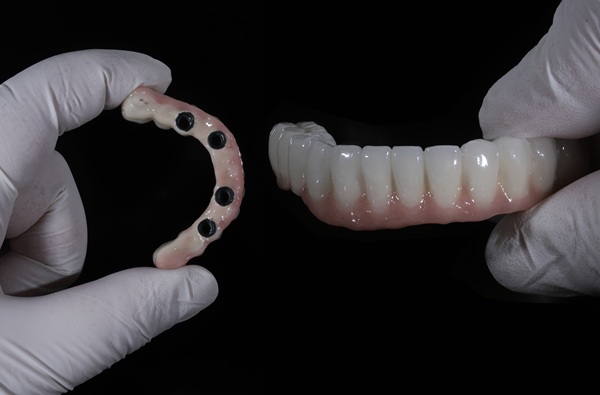
All-on-4® dental implants provide a sturdy and efficient way to replace a full arch of missing teeth. However, long-term results depend on careful planning and consistent maintenance. Reading up on the most common issues with this restoration can help you avoid them. That way, you can get a full, beautiful smile that lasts with all-on-4.
Supporting All-on-4 implants: How to avoid common problems
All-on-4 is a smile restoration that uses four dental implants to support a full arch of fake teeth. This solution is a more stable denture because it is anchored in the jawbone. Because of their placement, the implants can serve as replacement tooth roots, keeping the bone stimulated and preventing future bone loss.
This smile restoration can last a lifetime. But, as with any dental treatment, there is room for error; problems can arise for various reasons. Below, explore the most common problems with all-on-4 dental implants and how to help prevent them:
Healing issues
First, it is important to know that a dentist must surgically insert dental implants into the jawbone. The patient needs time to heal from this procedure, and the bone itself must have time to fuse with the implant in a process called osseointegration. Both healing phases are key to the all-on-4 treatment. If healing does not progress as expected, patients may notice tenderness or swelling that persists beyond the standard recovery time. In the worst cases, the implants can fail.
Poor habits and health
Smoking, uncontrolled health conditions, and poor hygiene at home place stress on the surgical area. The dentist helps reduce these risks by reviewing the patient's medical history and giving detailed aftercare instructions. Patients who follow the dentist's care plan are more likely to have a swift recovery and successful all-on-4 treatment.
Gum disease around the implants
Even though dental implants and false teeth do not develop cavities, the surrounding gums still require consistent care. Bacteria and plaque can accumulate around the implant sites, irritating the tissues that support the new teeth. Without treatment, this can lead to gum disease around the implants, also known as peri-implantitis. These problems can be easily avoided with good oral hygiene, mainly consistent brushing and dental checkups.
Excess pressure from an unbalanced bite
Bite issues often happen when patients grind their teeth or ignore small changes in the fit of the replacement teeth. A dentist can check the bite during placement and follow-up visits to ensure it remains even. A nightguard can also protect the new teeth when nighttime teeth grinding is an issue. A balanced bite keeps all-on-4 feeling natural and working as intended.
Problems with bone quality and implant placement
The success of all-on-4 treatment depends on the quality and the amount of available bone. If the jawbone is not strong or dense enough, the implants may shift or fail to fuse with the bone. Before treatment, the dentist will need to thoroughly examine the patient's bone density. In some cases, the patient may need bone grafting to rebuild an area of the jaw and provide support for implants. Following the dentist's recommendations can lead to a more successful all-on-4 process, even if it initially prolongs it.
Get better results with All-on-4
All-on-4 dental implants can restore a full smile with strength and stability. While there is a risk of complications, working with a dental team can help you avoid them with proper care and planning. Call our Glendale office today to learn more or schedule a consultation.
Request an appointment here: https://www.esthetixdentalgroup.com or call Esthetix Dental Group at (818) 638-0686 for an appointment in our Glendale office.
Check out what others are saying about our dental services on Yelp: All-on-4 Dental Implants in Glendale, CA.
Related Posts
Replacing a missing tooth with a dental implant supports long-term oral health and confident function. This tooth-root substitute anchors a custom crown, restores chewing, and helps protect neighboring teeth. With proper planning and care, implants also stimulate the jawbone, maintain facial shape, and simplify daily hygiene.A dental implant replaces a missing tooth root and supports…
Patients comparing implant crowns and traditional crowns often want a clear, practical explanation. Implant-supported crowns replace a missing tooth by attaching to a dental implant, which functions as an artificial tooth root placed in the jawbone. Traditional crowns cover and reinforce an existing natural tooth after decay, fracture, or a large filling. Both restore shape,…
Cosmetic dentists know that a beautiful smile goes beyond the appearance of the teeth. When too much of the gums show through when smiling, even perfect teeth can appear unusually short or small. Similarly, an uneven gumline may create an asymmetrical look that detracts from an otherwise beautiful smile. If you are unhappy with how…
Whether you are scheduled for a dental procedure that requires sedation dentistry or are simply interested in learning more about it before your consultation visit, understanding what sedation dentistry is and the different types that are available is helpful. In essence, sedation dentistry is a way to minimize discomfort and help the patient relax during…